Description
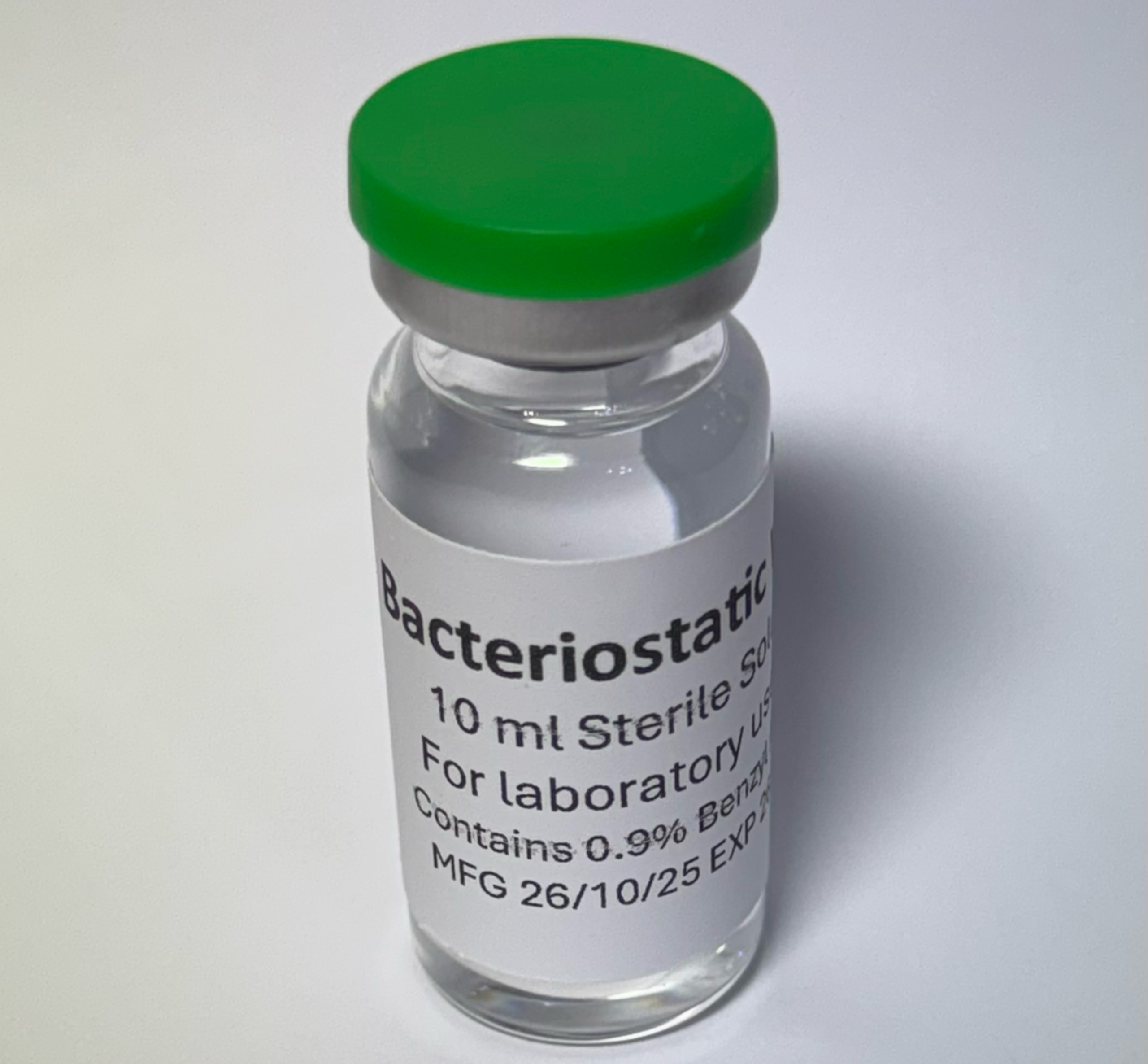
Bacteriostatic water for peptide reconstitution.
Sterile water + 0.9% Benzyl alchohol.
Research Only.
Buy Research Peptides Online UK Trusted


£6.00
Bacteriostatic water is a type of sterile water that contains a small amount of benzyl alcohol, typically 0.9%, which acts as a preservative. It is designed to inhibit the growth of bacteria after the container has been opened, allowing the same vial to be accessed multiple times without significant microbial contamination. This makes bacteriostatic water particularly useful in clinical, laboratory, and pharmaceutical settings where sterile solutions are prepared or diluted for repeated use.
Unlike plain sterile water for injection, which contains no preservatives and must be discarded after a single use, bacteriostatic water provides extended usability. The benzyl alcohol does not sterilise contaminated fluid, but it prevents the multiplication of bacteria that might be introduced during normal handling. This difference is crucial: bacteriostatic water is not a disinfectant, but a bacteriostatic agent, meaning it stops bacterial growth rather than killing bacteria outright.
The most common formulation of bacteriostatic water consists of water that meets pharmaceutical-grade purity standards combined with 0.9% benzyl alcohol. This concentration is carefully chosen. It is strong enough to inhibit microbial growth in the solution while remaining safe and chemically compatible with a wide range of pharmaceutical and laboratory compounds. Higher concentrations would be toxic and destabilising, while lower concentrations would not provide reliable protection against microbial contamination.
Sterility is achieved not only by formulation but also by filtration. Pharmaceutical-grade bacteriostatic water is typically filtered through a 0.22 micron (0.22 μm) membrane filter. This pore size is critical because it is small enough to remove bacteria, fungi, and most microbial contaminants from the liquid. Bacteria are generally larger than 0.3 microns, so a 0.22 micron filter provides a reliable physical barrier that produces a sterile solution without the need for heat sterilisation, which could alter chemical composition.
The filtration process works by forcing the liquid through the microporous membrane under controlled conditions. Particles, microorganisms, and debris larger than the pore size are trapped on the filter, while the purified water passes through into a sterile collection container. This method is widely used in pharmaceutical manufacturing, biotechnology, and laboratory preparation because it provides consistent, reproducible sterility without exposing the solution to high temperatures or radiation.
Once filtered, the bacteriostatic water is filled into sterile vials or bottles in a controlled environment, such as a clean room or laminar airflow hood. The addition of benzyl alcohol ensures that if small amounts of bacteria are introduced later through needle punctures or vial access, they cannot multiply and contaminate the entire solution. This allows one vial to be used multiple times, as long as proper sterile technique is maintained.
In practice, bacteriostatic water is widely used for reconstituting dry or powdered pharmaceutical products, diluting compounds for laboratory use, and preparing solutions that need to remain sterile over several days or weeks. Its stability, ease of use, and built-in antimicrobial protection make it an essential component of modern sterile preparation systems.
In summary, bacteriostatic water is a sterile aqueous solution preserved with 0.9% benzyl alcohol and produced using 0.22 micron filtration to remove microorganisms. This combination of physical filtration and chemical preservation allows it to remain safe and usable over multiple accesses, providing reliability and safety in both medical and scientific environments.
Bacteriostatic water for peptide reconstitution.
Sterile water + 0.9% Benzyl alchohol.
Research Only.